Hero / Introduction
Yellow Jambhala: A Talisman of Abundance and Grounded Ease
There’s a particular anxiety that doesn’t get talked about in spiritual circles. It’s not dramatic — nobody’s in crisis — but it’s there, underneath, a low hum of financial static. Will there be enough. Is the number in the account enough for what’s coming. Is the work sustainable. Is the pace sustainable. You can meditate, you can breathe, you can do all the practices — and the hum is still there, because it’s not actually about breathing. It’s about a felt sense of security that hasn’t been established yet.
The Tibetan tradition doesn’t separate abundance from spiritual practice. It doesn’t treat material wellbeing as a lower concern that spirituality transcends. It treats the felt sense of having-enough as a prerequisite for the inner work, not a distraction from it. A nervous system that’s running on scarcity doesn’t settle into meditation. It can’t. The body is too smart for that.
Yellow Jambhala is the archetype in the Vajrayana pantheon that addresses this directly — not by promising wealth, but by dissolving the internal pattern of scarcity that makes the nervous system believe there’s never enough, even when there is. This piece holds that function in visual form.
Product Description
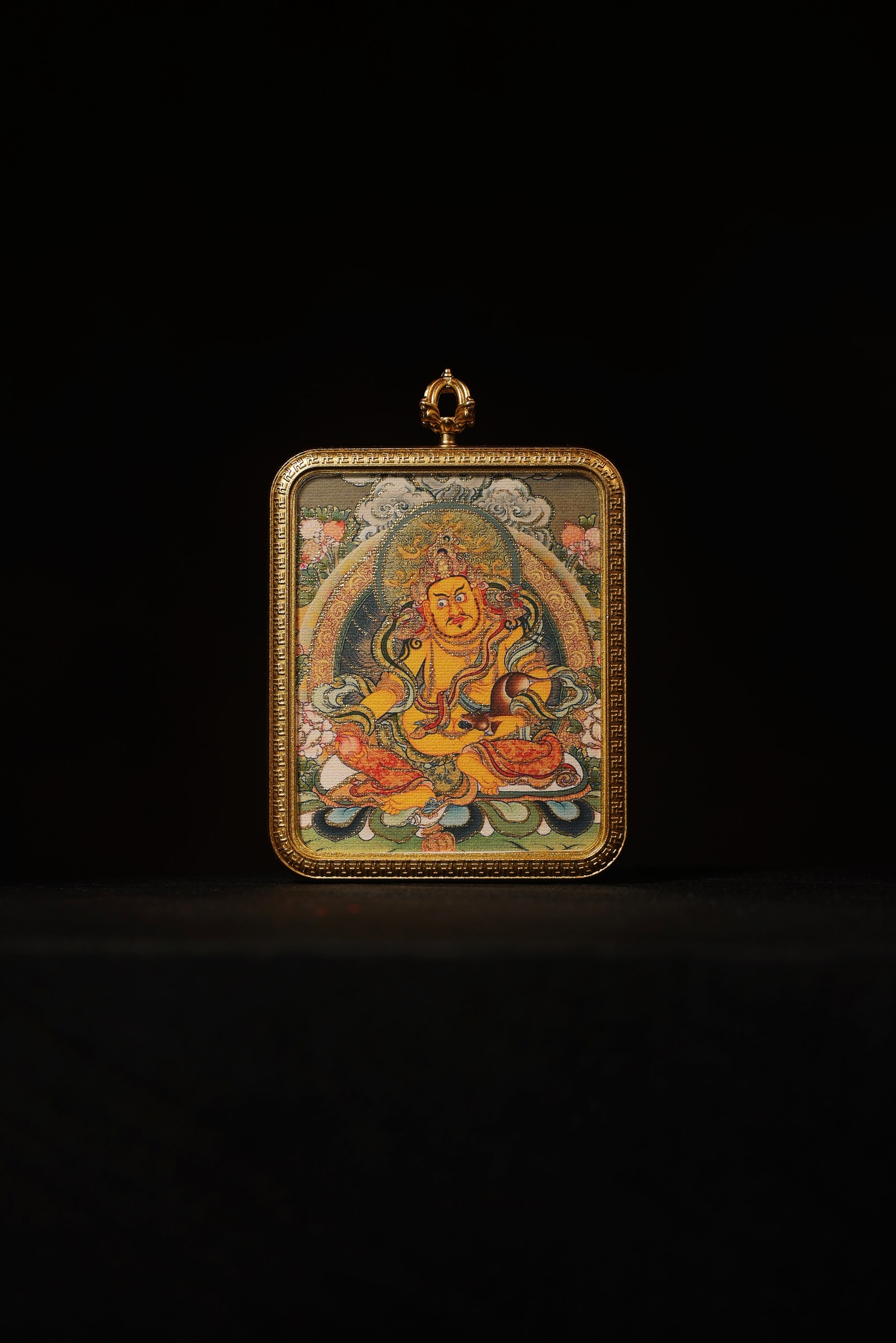
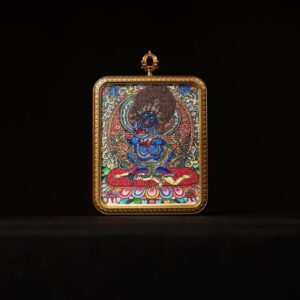
The painting is warm — warmer than the protector mandalas, warmer than the deep-blue wrathful forms. Yellow Jambhala sits on a lotus throne, his body the color of refined gold, not the cold metallic gold of bullion but the warm, honeyed gold of late afternoon light. His expression is unusual in the Tibetan pantheon: a subtle brow of intensity, not wrathful. Alert. Present. The face of someone who has been watching over the flow of resources for a very long time and knows how it works. His left hand holds the mongoose — the traditional symbol of the treasure-vessel that, when squeezed, produces gems and pearls without depletion. Not a metaphor for greed. A metaphor for the nature of true abundance: it doesn’t run out because it’s not a fixed quantity. It flows. His right hand holds a wish-fulfilling jewel, the symbol of the capacity to recognize what is already enough. Around him, lotuses bloom and auspicious clouds drift in tones of soft green and pale cinnabar — the palette of a landscape at peace.
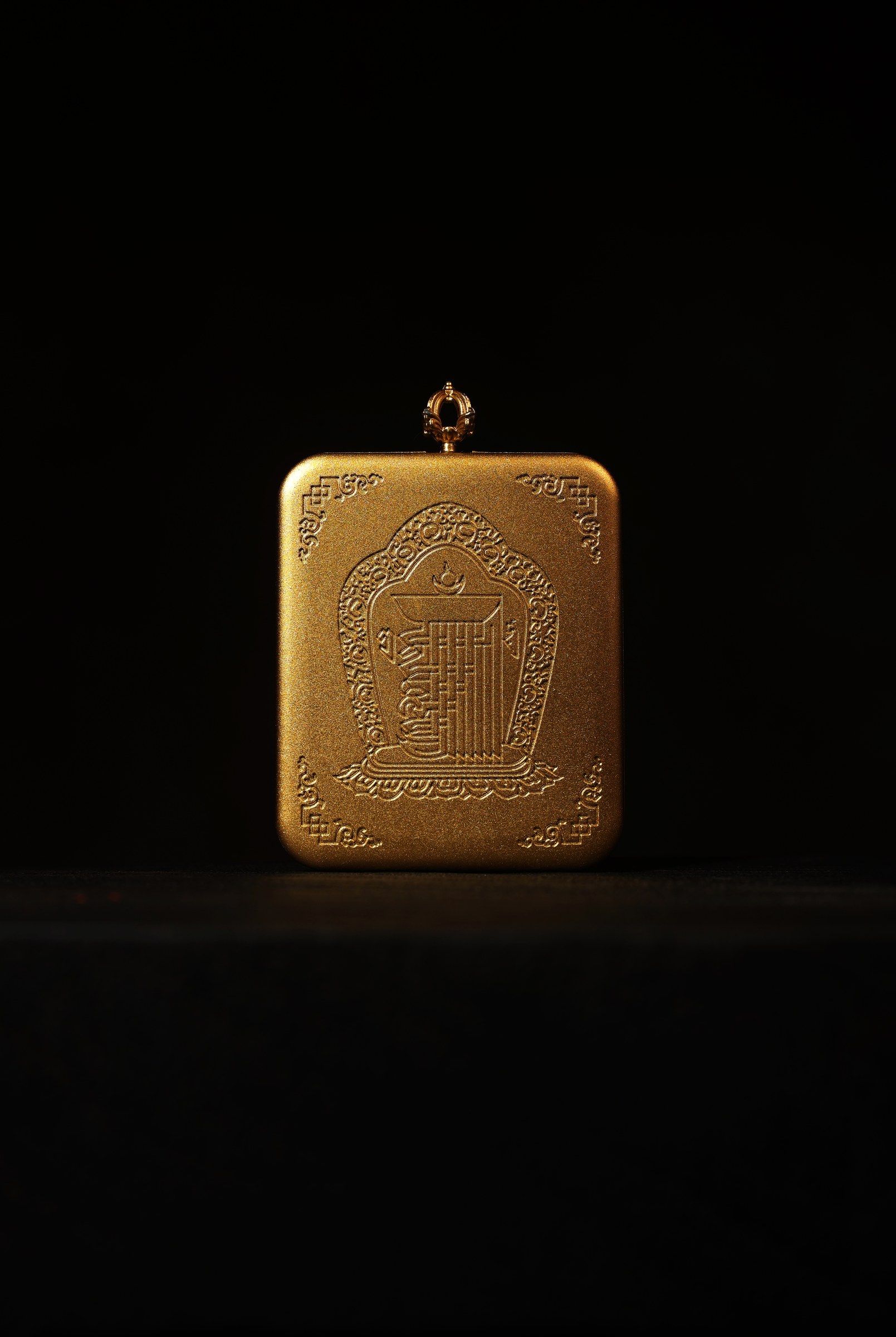
The gold-plated frame carries geometric scrollwork and will not tarnish. It stands on the included display base or hangs from the top Vajra loop. The gold of the frame echoes the gold of Jambhala’s form, so the piece reads as a single visual statement — warmth held in warmth.
As a semi-hand-painted piece, the warm gold body of Jambhala, the soft lotuses, and the delicate auspicious clouds are hand-rendered with fine brushes. The honeyed quality of the gold — that critical distinction between warm living gold and cold metallic gold — depends on the painter’s hand layering pigment with the right pressure and warmth. Each piece carries slightly different tonalities, ensuring no two are exactly alike. The mongoose, the jewel, the subtle expression — all bear the marks of individual craftsmanship.
Designed for dual use, this talisman can be worn as a pendant or displayed on a desk, shelf, or the heart of a home. The Vajra loop at top holds a chain or cord for wearing, placing Jambhala’s warm presence against the chest, where the felt sense of having-enough can be accessed through the day — a tactile reminder that the scarcity hum is a pattern, not a fact. Displayed on a surface, it becomes a presence at the hearth: the warm gold and soft lotuses carrying the specific frequency of sufficiency, reminding whoever is in the room that enough is not something to achieve but something to notice.
In the tradition, Yellow Jambhala’s function is layered. He dissolves the pattern of scarcity-consciousness — the internal program, often inherited, that runs ‘there is not enough’ regardless of external circumstances. He increases the felt sense of having-enough, which paradoxically changes one’s relationship to resources: decisions made from sufficiency are different from decisions made from fear. And he increases spiritual merit — the Vajrayana understanding that generosity flows from the experience of abundance, not toward it. You give because you have, not to get. The mongoose in his hand is the teaching: squeeze and it gives. The giving doesn’t deplete the source. The source is the nature of the thing, not the quantity it holds. To live with this image is to be reminded, daily, that the anxiety of not-enough is a pattern, not a fact.
Usage Scenarios
Daily Grounding Practice
Place it where you handle the practical matters of life — the desk where you pay bills, the table where you plan, the spot where you check in with your work. Before opening the spreadsheet, before reading the number — thirty seconds with Jambhala. The practice is not to ask for more. The practice is to feel the warmth of the gold, the calm of the lotus throne, and to let the nervous system register: there is a ground here. The scarcity pattern is loud, but it is not the truest thing in the room.
Wearable Abundance
Wear it as a pendant on a chain or cord, Jambhala’s warm gold presence resting against the chest. In the moments when the scarcity hum spikes — checking the account, opening the bill, the quiet comparison with someone else’s numbers — let the fingers find the talisman. The mongoose that gives without depletion, the jewel of enough, carried on the body. The practice in miniature: not asking for more, but feeling the ground that’s already here.
Home Heart Space
Rest it in the room where you spend your real time — not the office, not the entryway, but the place where you eat, where you rest, where the people you love gather. Yellow Jambhala’s warm palette was designed for this: not a shrine at the threshold, but a presence at the hearth. The lotuses and clouds and gold carry a specific frequency — the feeling of a life that is enough, held in visual form, reminding whoever is in the room that sufficiency is not something to achieve. It’s something to notice.
Reviews
There are no reviews yet.