
Hero / Introduction
Vajrasattva Hundred-Syllable Mantra Mandala: A Talisman of Purification and Renewal
There’s a particular weight that builds up over weeks. Not one dramatic event, but the accumulation — a conversation that left a residue, a decision you second-guessed, an old pattern you thought you’d outgrown showing up again in a new disguise. Layer after layer, so gradual you don’t notice until your shoulders feel like they’re holding something that isn’t even yours.
The Tibetan tradition has a word for what this is: karmic obscurations. Not a mystical concept removed from daily life — simply the grime that collects on the surface of awareness when it goes too long without being cleaned. And the tradition has a specific practice for cleaning it.
Vajrasattva is the archetype of pristine clarity in Vajrayana Buddhism — the embodiment of the mind’s original, unconditioned state. His Hundred-Syllable Mantra is considered the most thorough purification practice in the tradition, a hundred syllables of sound that dissolve the accumulated weight, one layer at a time. This mandala distills that practice into visual form.
Product Description
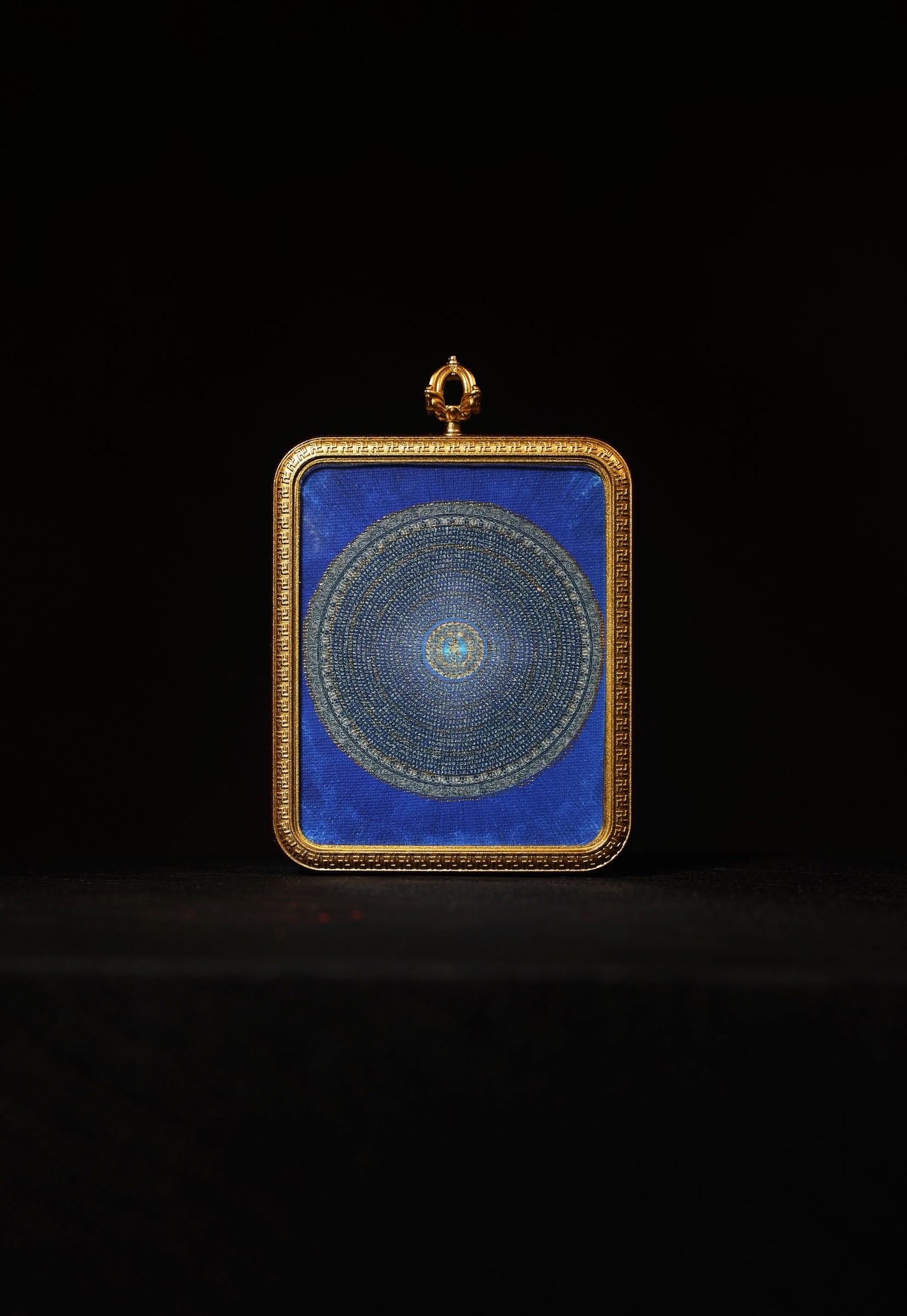
The backdrop here is lapis blue — not the midnight of the Avalokiteshvara mandala, but a brighter, clearer blue, the color of the sky after rain has washed everything clean. Against this field, the Hundred-Syllable Mantra spirals inward in tightly wound concentric bands, each character rendered in gold dust so fine it seems to float rather than sit on the surface. Because the mantra is long — a hundred syllables compared to the six of the previous mandala — the rings press closer together, creating a vortex effect. The eye reads it as a galaxy turning, or as a whirlpool, or as the way water circles a drain before it clears. It pulls you in gently, without force.
The gold-plated frame carries the same continuous swastika scrollwork — the ancient symbol of auspicious turning, a visual reminder that purification is not destruction but rotation, a turning-over of what has become stagnant. A Vajra loop at the top lets it hang; an included stand lets it sit. Neither position is more correct. The mandala does its work regardless of orientation.
As a semi-hand-painted piece, each ring of the Hundred-Syllable Mantra is individually brush-rendered by hand upon the lapis field. The sheer density of a hundred syllables means every piece demands hours of focused handwork, ensuring that no two mandalas are identical. The hand’s slight variations in pressure and spacing give the vortex a living, breathing quality that no machine can replicate.
Created for dual use, this mandala can be worn as a pendant close to the heart or displayed on a desk or nightstand. The Vajra loop at top serves equally as a bail for a chain or cord and as a wall-hanging point. Worn on the body, the purifying spiral accompanies you through the day’s accumulation; placed on a surface, it becomes a steady anchor for evening release practice. Both orientations serve the same function — the mandala works regardless of how you choose to hold it.
In practice, Vajrasattva practice is about the willingness to look at what you’ve been carrying without flinching and without dramatizing. The mantra doesn’t erase the past — it dissolves the grip it has on the present. People who sit with this mandala describe a sensation of something loosening, of internal space opening up that they’d forgotten was there. The tradition says it clears cognitive clutter, dissolves deep-seated energetic blockages, and restores the natural clarity that is the mind’s default state when nothing is obstructing it. The gold frame is cast to last — designed not to fade, not because it’s precious, but because some things should stay exactly as they are while everything else changes around them.
Usage Scenarios
Evening Release Practice
The day’s residue collects whether you notice it or not. Set this mandala where you’ll see it in the transition hour — after work, before evening settles in. Three minutes of soft gazing. The spiral composition was designed for this: the eye naturally follows the inward turn of the mantra rings, and the mind follows the eye, moving from the surface noise of the day toward something quieter at the center. Not analysis, not problem-solving — just a gentle unwinding.
Bedside Unburdening
Keep it on the nightstand for the moments when the mind replays the day on a loop — what you should have said, what’s waiting tomorrow. The deep lapis palette and the mandala’s turning geometry have a specific function here: they give the overactive mind a pattern to follow that leads inward rather than outward. Let the spiral do the work. You don’t have to force the calm. You just have to stop resisting it.
Wearable Purification
String it on a cord and wear it as a pendant through the day. The Vajra loop holds a chain or thread securely. As the body moves, the mandala rests against the chest — a quiet, constant companion for the accumulation that happens between morning and night. When the weight builds, fingers find it. The spiral under your touch is the practice in miniature: turning, turning, clearing.

Reviews
There are no reviews yet.