
Hero / Introduction
Kalachakra Mandala: The Architecture of Time, Drawn in Stillness
You know the feeling: too many days in a row, too much held, too much carried. The week becomes a blur. The year disappears. You find yourself in a season you don’t remember entering, doing things you don’t remember signing up for. The body’s sense of time becomes a sensation of falling, and the mind stops trying to track it. The wheel, as it turns, is also turning you.
The Kalachakra — the Wheel of Time — has been the teaching that names this. Not a teaching about getting time back, not a productivity technique, but a teaching about the actual architecture of time itself: that it is both the turning and the still point, both the passing and what does not pass. The mandala is that architecture, drawn so you can see it at a glance.
Product Description
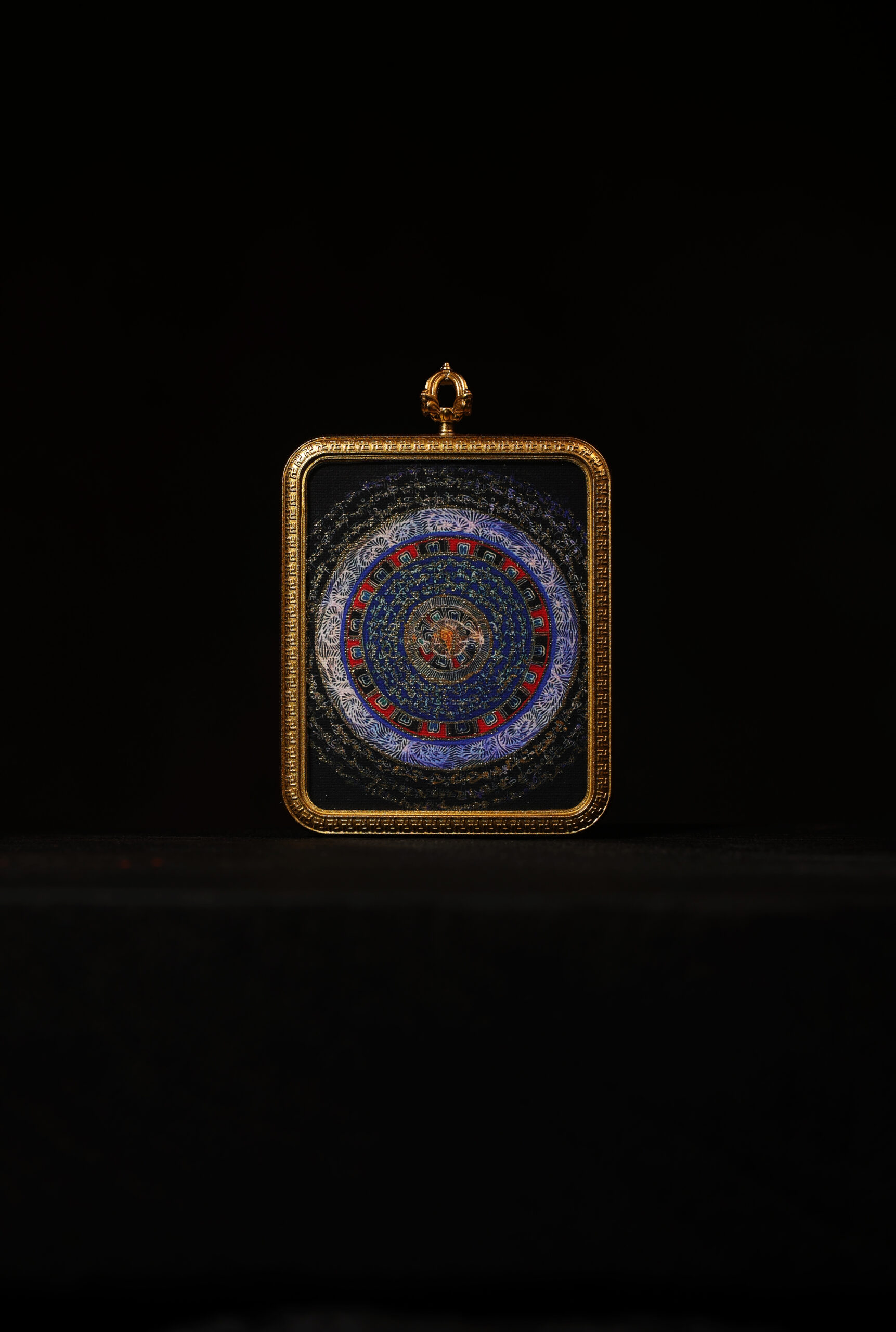
The mandala is rendered against a field of deep midnight blue — the blue of the sky in the hour when the stars are brightest and the night feels endless. At the center, the seed syllable of Kalachakra is laid in gold, and from this center, the concentric architecture of the tantra unfolds: the inner palace of the deities, the four directional gates, the protective rings of vajra fire, and at the outer edge, the boundary that seals the sacred space. The cast base is the structural foundation — precise, even, holding the geometry steady — while the micro-fine Sanskrit characters at each ring are applied by hand with a fine-tipped brush, each one laid with the steadiness of a person saying a prayer that matters. The marriage of the two gives the piece both durability and breath.
The Kalachakra is one of the deepest and most integrative tantric systems in Tibetan Buddhism — a complete cosmology that sees the inner and outer as the same architecture viewed from two directions. The body is cosmos. The breath is time. The subtle energies are the movement of stars. The mandala is that teaching condensed into image: a single glance that holds the whole architecture of time, both its turning and its still point. To sit with this mandala is to sit with the proposal that you are not in time, separate from it. You are time, manifesting. And at your center is the place that does not move.
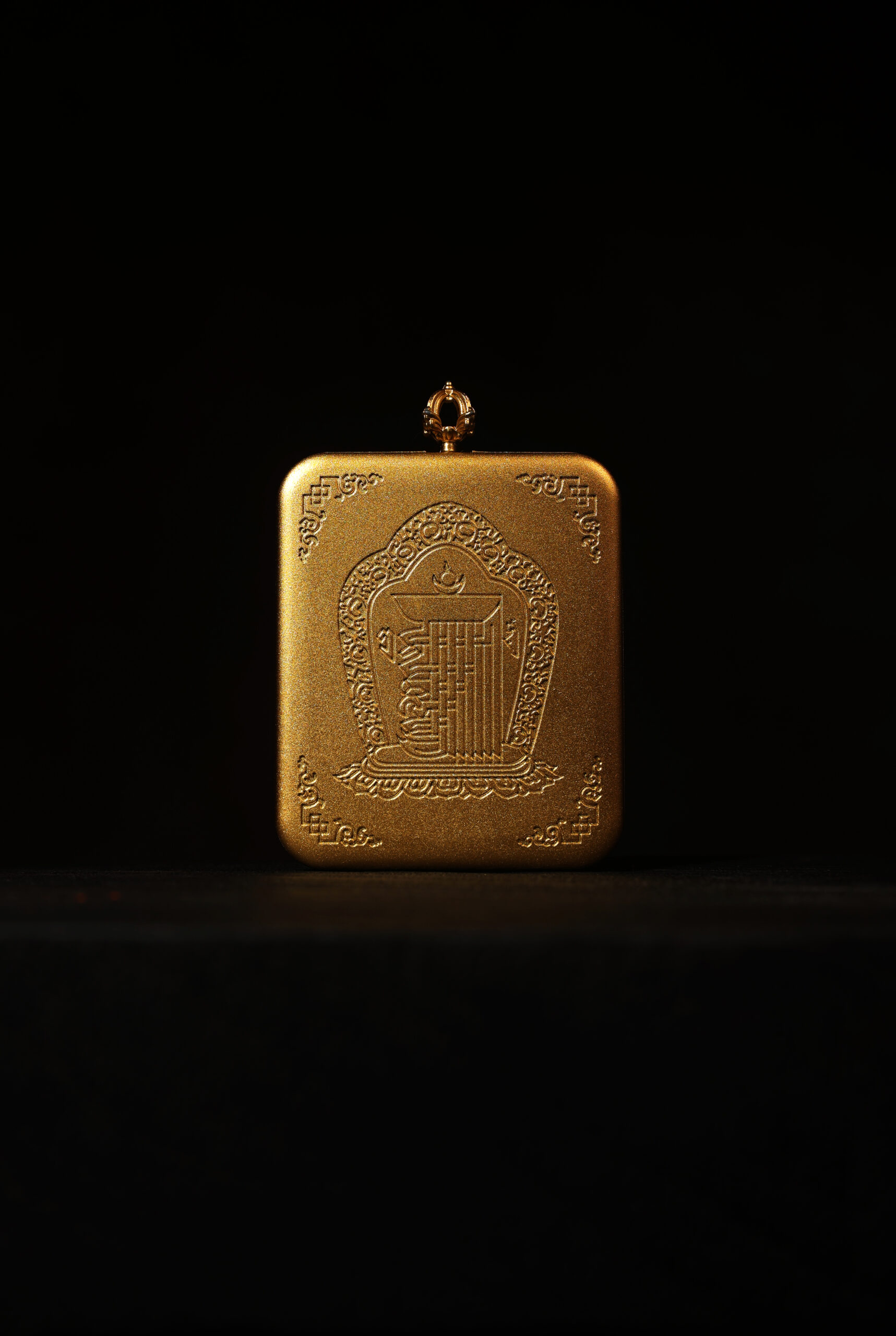
The frame is cast in gold-plated metal with a continuous swastika scrollwork — the symbol of auspicious turning, in continuous unbroken flow. It will not tarnish or fade. A Vajra loop at the top allows hanging on wall or wear as a pendant; the included display stand lets it rest upright. Designed for dual use: place it where the hours feel heaviest — the office, the desk, the bedside — or carry it on a chain against your chest through the days that feel like they are passing through you too fast.
Semi-hand-painted. The base is cast with precision — the geometry, the gates, the protective rings. The mantra characters and central details are applied by hand, stroke by stroke, with a fine-tipped brush. The craftsmanship bridges the precision of casting with the warmth of the human hand, giving the surface a subtle vitality that pure machine production cannot replicate. When you sit with it, the nervous system — the part of you that tracks the passing hours — begins to slow. Not because time stops. Because the composition speaks directly to the still point. The wheel keeps turning. You, at the center, can also rest.
Usage Scenarios
Wearable Anchor on Over-Scheduled Days
Thread a chain through the Vajra loop and wear the mandala through the over-scheduled days — the ones with too many meetings, too many handoffs, too much held in too short a window. Each time your fingers find the pendant, you are reminded: the wheel is real, but the still point is also real. You are the center the day turns around. You don’t have to be carried by the turning.
Bedside Companion at the End of a Long Week
Place it where the week is reviewed — the nightstand, the corner of the dresser, the place where the day ends. The deep midnight-blue palette was chosen for this hour. Before sleep on the last evening of the week, rest your eyes on the central syllable. The week that just passed is one full rotation. The week that will come is another. The still point at the center is where you live. Rest there before the next turn.
Workspace Anchor for Slowing the Spin
Place the mandala on the desk where the work accumulates. When the day has narrowed your attention to the urgent — the deadline, the message, the task — lift your eyes to the central syllable. Thirty seconds. The Kalachakra does not ask you to stop working. It asks you to remember that you are the still point the work turns around. The work is real. The center is also real. Both are available, all at once.
Reviews
There are no reviews yet.