

Hero / Introduction
Green Tara Mandala: The Swift Compassion That Arrives Before You Ask
There is a kind of fear that has no name. It is not the fear of something specific — not the diagnosis, the call, the door opening. It is the low-grade hum of a nervous system that has been on alert too long. The body holds a posture of readiness that no longer matches what is actually happening, but the body does not know that. It just keeps bracing. Bracing for the next thing, and the next, and the next. Until one day you realize you have been bracing for years.
Green Tara has been the one held close at those hours. The swift one. The fearless one. The female Buddha of immediate compassionate action — not the long-protracted, gradual healing of some deities, but the swift, untangling, here-now response. She is the one who looks at the bracing and says: I see you. I am already here. You can put it down. Green Tara is the speed of grace arriving before you finish asking.
Product Description
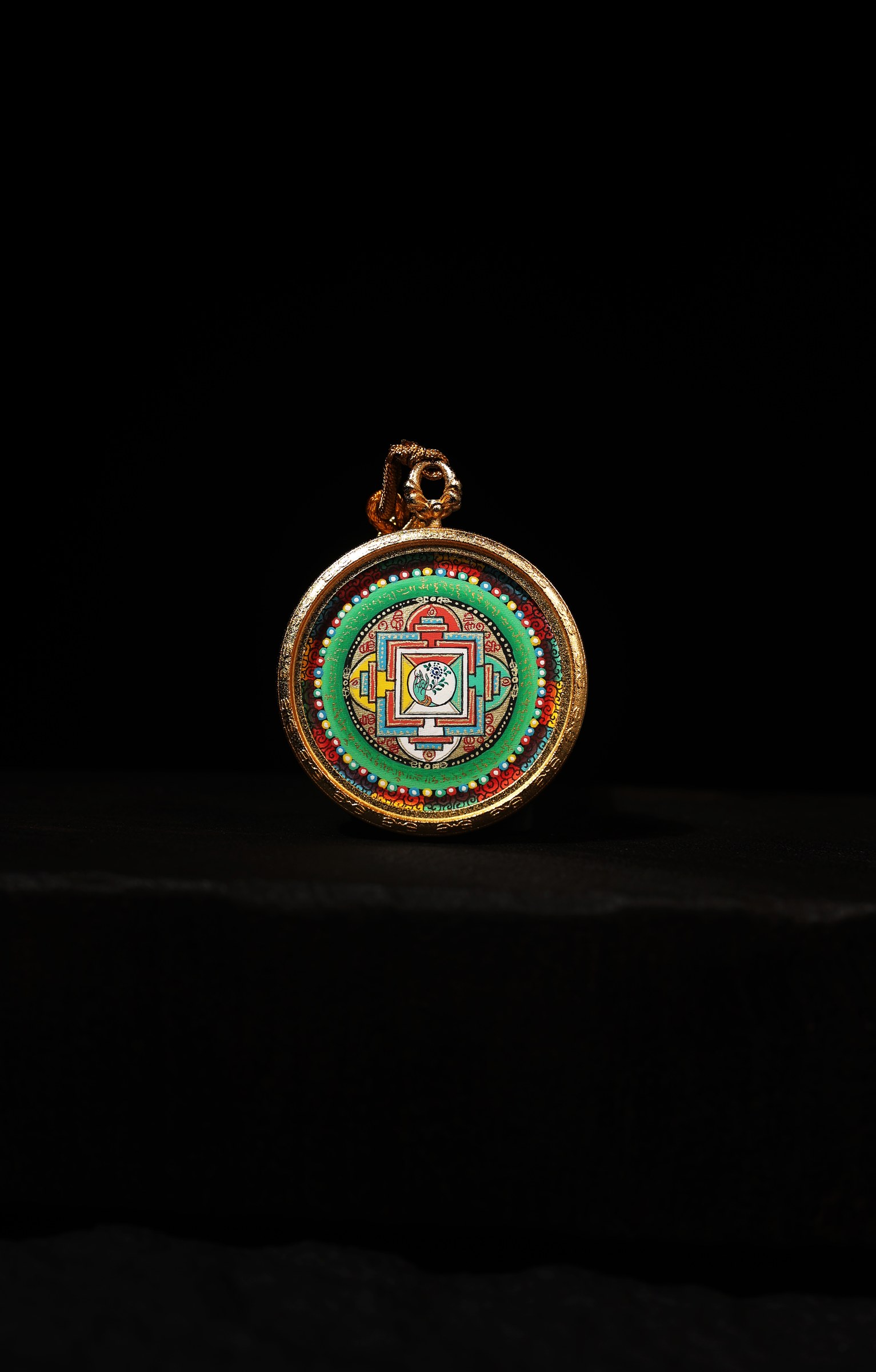
The mandala is painted against a field of deep forest green — the green of old-growth woods at dusk, when the light has nearly left but the trees are still themselves. From this green depth, Green Tara’s seed syllable emerges at the center, laid in pure hand-applied gold, the brush strokes fine enough to look almost woven into the field. Surrounding the center, concentric rings of her mantra — OM TARE TUTTARE TURE SOHA — spiral outward in micro-fine brushwork in cinnabar red and pale gold, each syllable placed by hand with the attention of a person saying a prayer. The whole composition is a focused field of her energy: not an image of Green Tara, but the architecture of her swiftness, drawn around the central syllable of her name.
Green Tara is the goddess of immediate compassionate action — the swift responder, the one who is already there when you arrive at the edge of the cliff. Her mantra is one of the most recited in Tibetan Buddhism, in part because it works on the body’s fear-system directly. Where other deities might promise eventual liberation, Green Tara says: the fear can lift now. The body can remember it is held. The bracing can release. The mandala is her presence condensed: a field of green and gold that the body’s nervous system recognizes, even when the mind has forgotten what it is asking for.
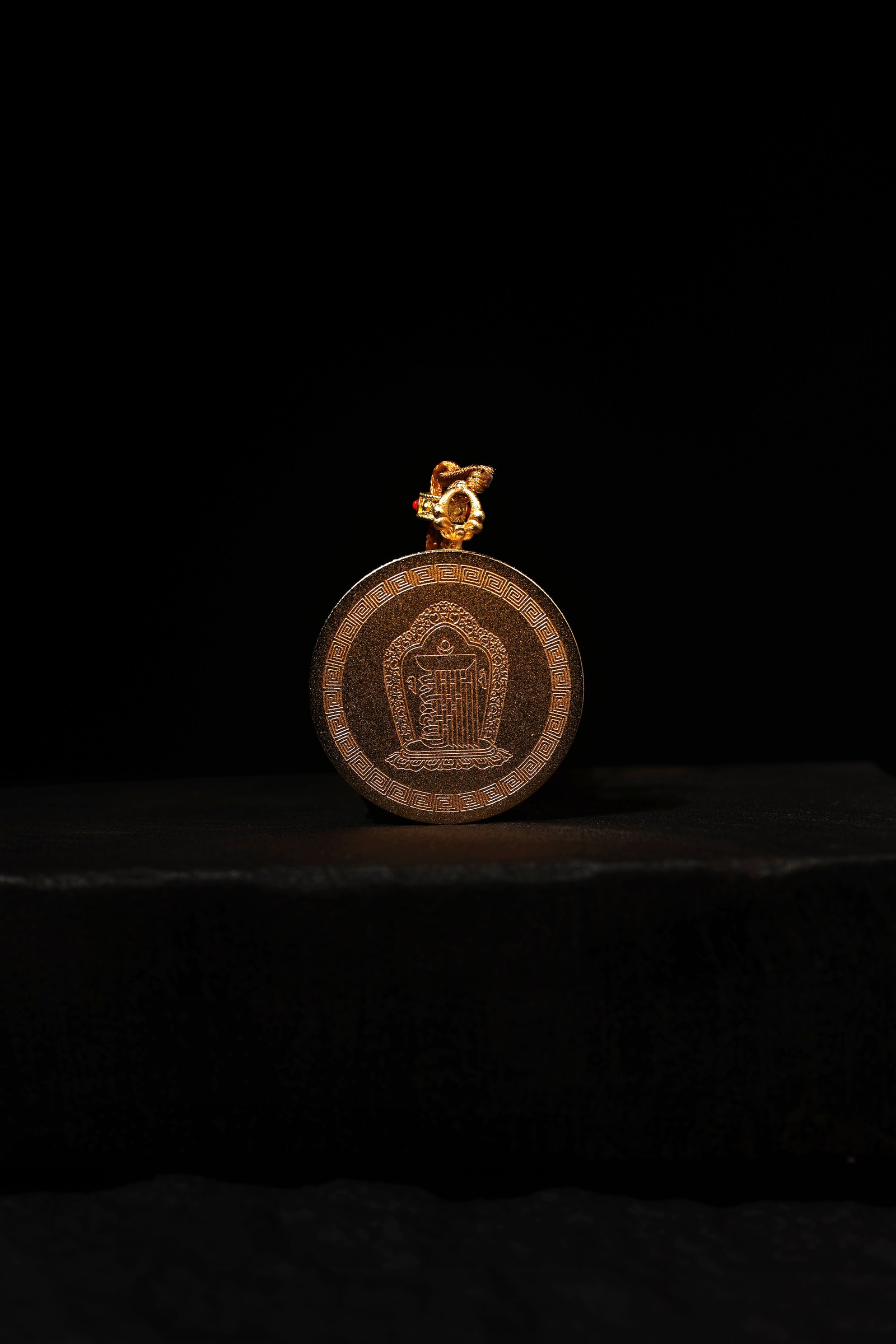
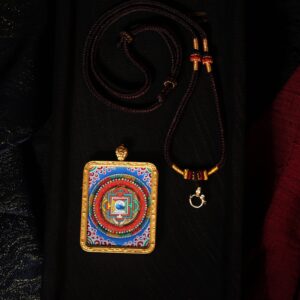
The frame is cast in gold-plated metal and etched with lotus petal scrollwork — the lotus being Green Tara’s seat, and the symbol of what grows from the mud without being stained by it. It will not tarnish or fade. A Vajra loop at the top allows hanging on wall or wear as a pendant; the included display stand lets it rest upright. Designed for dual use: place it where the bracing happens — the bedside, the desk, the place where the body holds its quiet fear — or wear it on a chain against the chest through the seasons of long alert.
Pure hand-painted. Every line was placed by hand with the precision of a person who understood: the body’s nervous system responds to the quality of attention, not the quantity of decoration. The piece is intricate but not busy. When you sit with it — even just a minute, eyes on the central syllable — the bracing begins to soften. The body’s fear-system receives a message older than language: there is a swift one. She is already here.
Usage Scenarios
Bedside Companion for Releasing the Bracing
Place it on the nightstand where the day’s accumulated tension is held. The body’s fear often peaks in the hour before sleep, when the distractions thin and the bracing has nowhere to hide. Sit with the mandala for two minutes before turning in. Let the central syllable send the message into the body’s deepest layer: there is a swift one. She is already here. You can put it down for the night. Sleep can come.
Wearable Anchor Through Long Seasons of Alert
Thread a chain through the Vajra loop and wear the mandala against your chest through the long seasons — the ones that don’t have a name, the ones where the bracing has just become the body’s default setting. Each time your fingers find the pendant, Green Tara’s swift energy meets the body’s held fear. The message is the same each time: the fear can lift now. The body can remember it is held.
Daytime Return Between Tasks
Place the mandala on the desk where the work happens. Between tasks, between meetings, between the version of you that performs and the version that breathes — lift your eyes to the central syllable. Thirty seconds. Green Tara’s mantra is recited precisely for these gaps — the small in-between spaces where the body can remember it is more than what is being asked of it. The swift compassion doesn’t need a retreat. It can arrive in the half-second between one task and the next.

Reviews
There are no reviews yet.