
Hero / Introduction
Six-Armed Mahakala: A Talisman of Protection and Inner Liberation
Some protection is quiet. A closed door. A boundary stated gently. That kind of protection works for ordinary friction. But there are seasons when what’s coming at you is not ordinary — when the patterns are deeper, the resistance more entrenched, the old loops cycling with a force that gentle boundaries can’t hold. Sometimes you need the version that doesn’t apologize for its force.
The six-armed form of Mahakala is that version. In the Tibetan pantheon, the number of arms correlates to the scope of what a deity can address: two arms for straightforward protection, four for broader terrain, six for the full catastrophe. Six arms for the complete dismantling of everything that stands between you and your own clarity. This is the form you turn to when the situation is complex and the obstacles are not on the surface.
Product Description
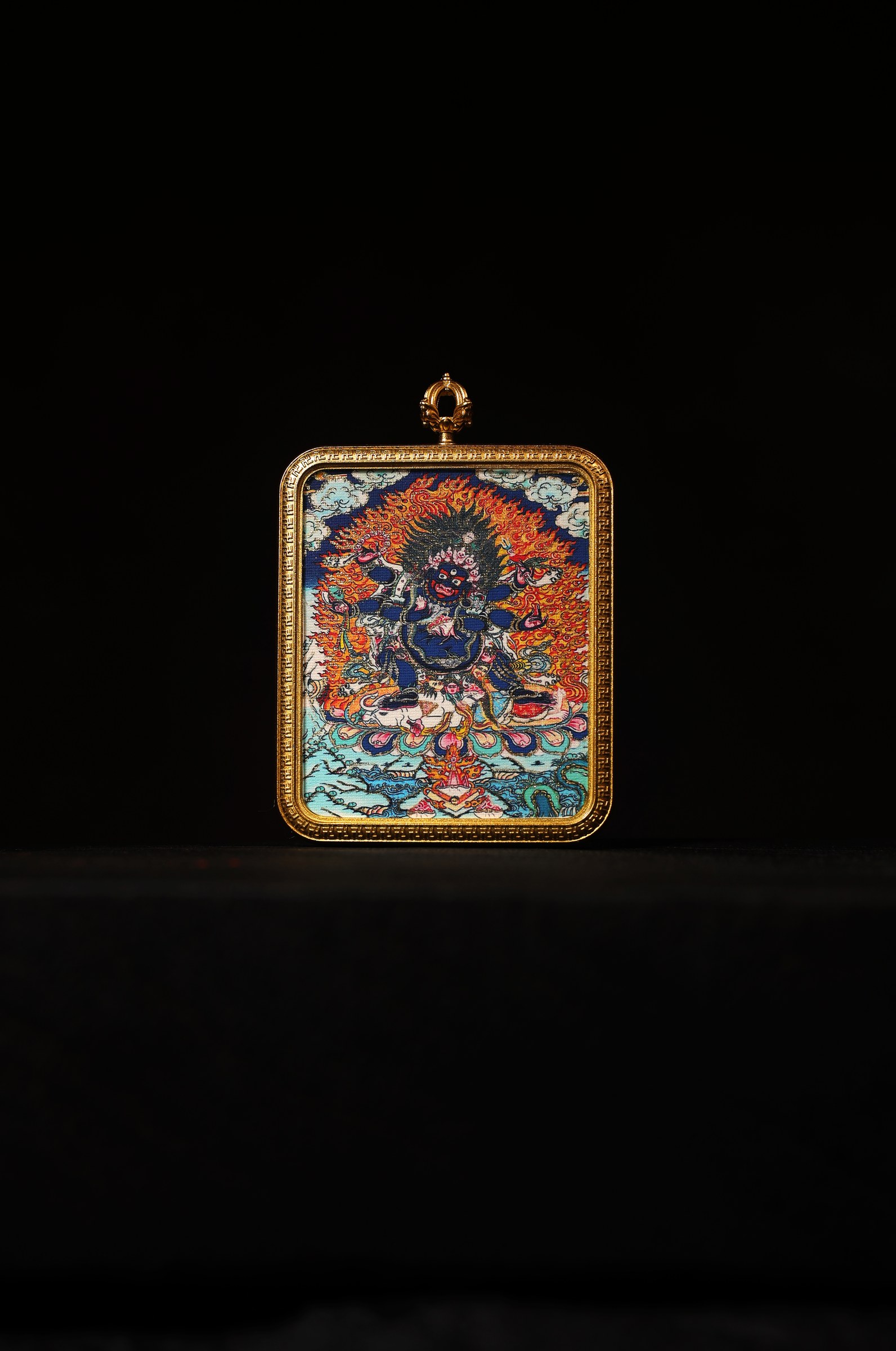
The painting is dense with iconography, and every element does work. Mahakala’s deep-blue form stands on a lotus seat, encircled by a blaze of wisdom fire rendered in gold dust and vermilion — not the fire that destroys but the fire that refines, the one that burns away what isn’t essential. His six arms hold six implements, and each one corresponds to a specific function: the curved knife that severs attachment, the skull cup that transforms poison into nourishment, the rosary that tracks the continuity of awareness, the trident that pierces through the three poisons of ignorance-attachment-aversion, the damaru drum whose sound is the pulse of impermanence, and the elephant skin — the shedding of the heavy, the stubborn, the resistant. Beneath his feet, the elephant-headed deity Ganesha lies subdued, symbolizing not the defeat of a rival god but the taming of the obstacle-remover himself: when even obstacles are brought under the protector’s authority, there is nothing left to block the path.
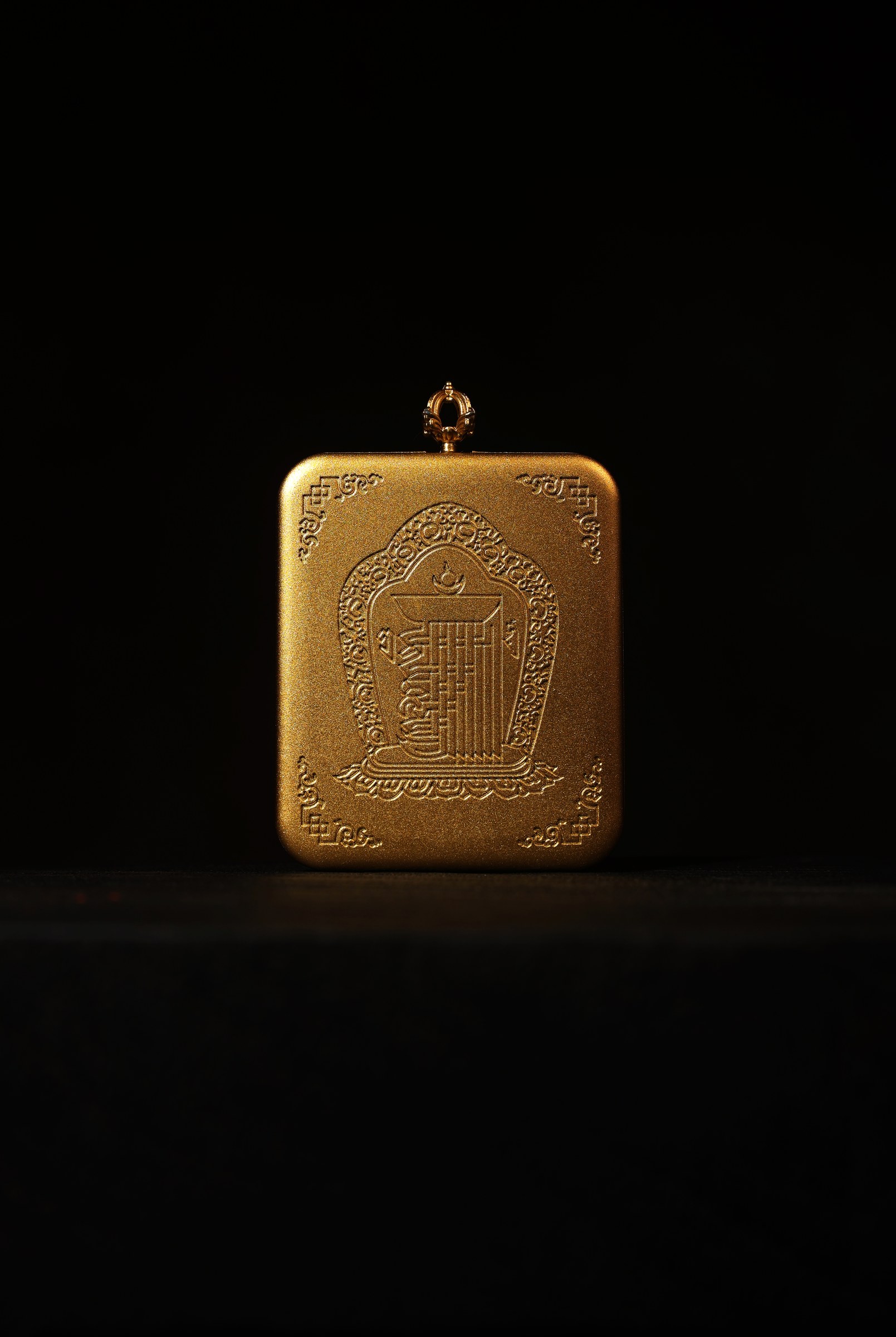
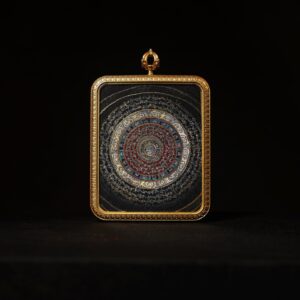
The color palette is unusually rich for a protector deity — gold stardust and fiery vermilion against the deep navy of Mahakala’s skin, with the lotus seat and surrounding clouds in softer tones. The effect is not somber but dynamic, alive with the energy of active transformation. The gold-plated frame carries geometric scrollwork and will not fade. It stands on the included acrylic display base or hangs from the top Vajra loop.
This piece is semi-hand-painted: the six implements, the wisdom-fire halo, and the complex iconographic details are hand-rendered with fine brushes on each individual piece. Given the extraordinary density of elements — six arms, six implements, the subdued Ganesha, the blaze of flame — each painting requires sustained handwork, and no two are exactly alike. The hand-applied gold dust gives the fire a living shimmer that shifts with the light.
Designed for dual use, the Six-Armed Mahakala can be worn as a pendant or displayed on a desk, altar, or shelf. The Vajra loop at the top holds a chain or cord securely for wearing, placing the most complete form of the protector against the chest. Worn, it travels with you through complex terrain — the six-armed presence a portable force-field against deep patterns and entrenched obstacles. Displayed, it becomes the sovereign guardian of a space, its dense iconography teaching by its sheer visual presence. Both modes serve: the dismantling happens wherever the image is.
In the Vajrayana tradition, the six-armed form is understood as the most complete expression of the protector’s function: not just guarding the perimeter but actively dismantling what’s inside it that doesn’t belong. Deep-seated patterns. Generational tendencies. The kind of obstacles that feel like they’ve been with you longer than this lifetime. The six implements are not decorative — each one addresses a different layer of what needs to be cleared. To sit with this image is to sit with the archetype of total, unsentimental clearing. It’s not always comfortable. It is always effective.
Usage Scenarios
Deep Pattern Work
Place it in your meditation space when you’re working with something that won’t yield to surface-level practices. The six-armed form is for the terrain that gentle methods can’t reach — entrenched habits, inherited patterns, the kind of stuckness that feels structural rather than circumstantial. Sit with the image. Let the iconography teach: six implements, six layers, the elephant of ignorance already underfoot. The obstacle is not as large as it feels.
Wearable Protector
Wear it as a pendant on a sturdy chain or cord, the six-armed form resting against the chest. In terrain that feels entrenched — difficult conversations, old patterns reactivated, environments where the same loops keep cycling — let the fingers find it. Six implements, six layers of clearing, carried on the body. The protector goes where you go, and the dismantling doesn’t wait for the meditation cushion.
Commitment Space
Place it where you do the work that matters most — the desk where you write, the table where you build, the corner where you sit with the thing that requires your full self. The tradition says Six-Armed Mahakala shatters obstacles and severs inner illusions. When the resistance to your own work is strong, the image is a reminder that the resistance is not as solid as it feels. It can be met. It can be moved. Six arms are more than enough.
Reviews
There are no reviews yet.